Concept
Writing about people and the way they live
Kitagi Ukyo’s fiction explores human relationships, identity, diversity, and the ways people live together.
His stories often focus on people who experience the world differently from those around them.
Rather than presenting diversity as an abstract idea, he portrays it through the lives, choices, relationships, and everyday experiences of individual people.
Literature and normalization
One of the central ideas in his writing is normalization.
What does it mean for people with different backgrounds, experiences, and ways of seeing the world to live together?
His fiction approaches this question through individual stories rather than through explanations or arguments.
Continuing to write
Kitagi Ukyo continues to write and publish independently, developing his work across both digital and print formats.
His aim is to create fiction that remains with the reader and invites them to look again at the people and society around them.
Why I Choose Handwriting in the Digital Age of the 21st Century
Hello, and welcome.
Whether you are visiting for the first time or have been reading my work for some time, I’m glad you are here.
I am Ukyo Kitagi (Kitagi @ Creative Notes).
Voice. Presence. Words.
I believe that something essential about a person can reside in the things we cannot see.
From that realization, I have continued writing stories centered on themes of hope and renewal.
Why I Choose Handwriting in the Digital Age
Today, when people talk about writing a novel, it is common to sit in front of a computer and type with a keyboard.
Some people write on their smartphones.
In the future, more writers may choose to write using voice input.
In a sense, it may be similar to what was once called dictation.
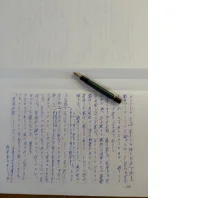
Yet even in this age, I still write my novels by hand on Japanese manuscript paper with a fountain pen.
The reason is very simple.
It suits me best.
Japanese manuscript paper is divided into squares, with 400 characters on each sheet.
For me, these individual spaces create a natural rhythm for writing.
Some people may find the squares restrictive.
For me, it is the opposite.
Because each space is clearly defined, I find it easier to feel where each word belongs.
Of course, if we think only in terms of efficiency, computers are superior.
Corrections are easy, and sentences can be moved around freely.
Even so, handwriting gives me a feeling that is different from digital writing.
This is simply my own experience, but when I write by hand, I feel as though I am using both my mind and my body more fully than when I type digitally.
We type messages, social media posts, and emails almost without thinking.
If you try writing some of those things by hand, you may begin to notice the difference in what it means to actually “write.”
Writing is not simply an intellectual activity.
It is a process of thinking, moving the hand, and engaging with words through the whole body.
The Time Created by Handwriting
One of the advantages of handwriting is that you cannot write too quickly.
You may need to remember how to write a kanji character, or check whether a hiragana character is correct.
While writing a single character, a small amount of time appears in which you can think about the next word.
Within that brief pause, I can ask myself:
“Will this word really convey what I want to say?”
“Will this expression allow the character’s feelings to reach the reader?”
When writing fiction, it is important not only to describe events, but also to portray human emotions and the subtle movements of the heart.
I feel that there is value in having time to stop and think rather than immediately searching for an answer.
Manuscript Paper and the Accumulation of a Story
Japanese manuscript paper is divided into individual sheets.
One page, then another.
By continuing to fill them, the story gradually begins to take shape.
Four hundred characters at a time eventually become an entire novel.
On a digital screen, you can see how many characters you have written.
But with manuscript paper, I can actually see how far I have traveled.
Seeing that accumulation gives me the strength to continue writing.
I also use a fountain pen because I find it comfortable for long periods of writing and feel that it puts less strain on my hands and fingers.
I continue to use a style of writing that has been passed down through the Meiji (1868–1912), Taisho (1912–1926), and Showa (1926–1989) eras, even in the 21st century.
I do not do this to resist the times.
Digital technology has its conveniences.
But when I write fiction, what I seek is not speed alone.
The time it takes for a word to emerge.
The time spent thinking about what a character is feeling.
The time spent facing the story itself.
I believe all of these moments are part of the creative process.
That is why I still choose to write by hand.