
Writing a Novel from Start to Finish —
How I Approach an 80,000-Word Story
To those visiting for the first time, and to those who have been reading my work for some time:
I’m Ukyo Kitagi (Kitagi @ Creative Notes).
Voice, presence, words—
I believe that the essence of a person can be found in things we cannot see.
With this realization as the foundation of my writing, I continue to create stories centered on hope and renewal.
This time, I would like to write about how a novel gradually takes shape, from the initial writing to the process of revision.
How Do I Approach a Novel of 80,000 Words or More?
Before working out the details of the story, I first decide approximately how long the novel will be.
This is not simply a matter of willpower, but unless I make that decision at the beginning, the work will never be completed.
I decide:
I am going to write this book.
That is where the writing begins.
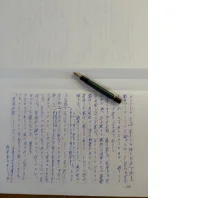
I mentioned a novel of more than 80,000 words, but I actually write my first drafts by hand on Japanese manuscript paper.
As I write, I do not measure my progress by the number of words on a computer. Instead, I count how many manuscript pages I have completed.
I only know the exact word count after I type the manuscript into a computer.
It varies from one work to another, but my novels are generally around 200 to 300 pages of genkō yōshi, traditional Japanese manuscript paper with 400 character spaces per page.
Each time I begin a work, I decide roughly how many manuscript pages I intend to write.
In a single writing session, I usually write somewhere between seven and eleven pages.
Most often, I write ten pages at a time.
For example, Landscapes of Normalization (Normalization no Fūkei) was approximately 200 manuscript pages.
If I write ten pages each time, I can reach 200 pages in about twenty writing sessions.
Of course, the amount I can write varies from day to day.
But this approach does not work:
“I wrote fifteen pages today, so next time I only need to write one.”
Or:
“I only managed one page today, so I’ll make up for it next time.”
If three pages is your rhythm, keep writing three pages each time.
What matters is maintaining a steady rhythm.
Rhythm is extremely important in writing.
I believe that continuing to move at the same rhythm gives us the strength to keep writing until the very end.
Do I Write the Story in Order, from Beginning to End?
Basically, yes. I write from beginning to end, in order.
The longer a novel becomes, the easier it is to lose sight of the overall flow of the story if I write only isolated scenes along the way.
In the first draft—the earliest stage of writing—I continue writing whatever comes to mind.
At this point, not every detail is completely settled.
There may be things that need to be changed later, such as the names of characters or places, but I keep moving forward.
My first priority is to complete the work once, all the way to the target number of manuscript pages.
While writing, I may also think:
“I want to add something to an earlier page.”
Or:
“I need to revise this part later.”
When that happens, I leave myself a note and continue writing.
When Do I Rewrite and Revise?
I rewrite many times.
For me, the real work of writing begins after I finish the first draft.
A first draft is still something that has yet to be shaped into the finished work.
What do I want to portray?
What do I want to express?
What kind of story do I want to place in the reader’s hands?
By rewriting again and again, the answers gradually become clearer.
Some people may feel that once the first draft is finished, the work is done.
But to me, writing means continuing to write.
And continuing to rewrite.
I also revise the manuscript in order, basically working from beginning to end.
If I were to compare rewriting to baseball or football, I would say it is like practice.
You keep swinging the bat day after day.
You practice taking shots again and again.
It is this accumulation of practice that determines how well you can perform when it is time for the game.
Revision in writing works in much the same way.
I return to the parts I could not express as I wanted and gradually refine them.
It requires patience, but it is indispensable to completing a book.
After revising a manuscript many times, something curious happens.
Eventually, I begin to see the end.
It is difficult to explain because it is something I feel intuitively, but a moment finally arrives when I know:
This is enough. The work is complete.
Thank you for reading to the end.
Through writing, I hope to cast light on the things we cannot see—
and I will continue, quietly, weaving words together.